
Run a cable. A separate supply and meter by the drive means a new connection from the network operator, which is usually the slower and more expensive route, with their own charges and timescales. A cable run of 30 metres or more from the house is very common, and in most homes it is the sensible option. The cable is sized for the length so the charger gets full power, and it can run along walls and fences or underground in ducting, whichever suits your garden.
Why a cable run wins in most homes
A home EV charger needs its own circuit from your fuse board, with its own protection. Where the car parks is a question of distance and route, not of electricity supply. A longer run needs a thicker cable, and the quotation reflects that, but it is still one job on one day. A second supply involves the network operator, a second meter and a second standing charge, and you wait for their programme rather than ours.
The exception is a drive or garage with no sensible route back to the house at all. That is rare, and the video walkthrough described below tells us quickly if it applies to you.
How the cable gets from the fuse board to the car
Every house is different, but the route is built from the same few pieces.
- Inside the house. White PVC trunking in a corner we choose with you, or externally up the wall and in at the soffit. You tell us which you would rather look at.
- Through the loft. The usual way across a terraced house when the fuse board is at the front and the parking is at the back.
- Down the outside. Along the junction between two houses or beside a drainpipe, to ground level. If that means working above a single-storey extension roof, see the access question below.
- Across the garden. Armoured cable along the base of a fence, secured so nothing needs digging up, or in ducting in a trench.
- At the car. On a wall, or on a post with a concrete base where there is no wall. If the parking space or the land beside it belongs to a management company or a developer, we need their agreement before a post goes in.
A shared path, a patio, or a neighbour’s drive in the way
A cable can never be clipped along a shared path or across a neighbour’s frontage. It would be a trip hazard for everyone who walks there. Under those, the cable goes underground. In your own garden that means lifting the slabs along the route, laying the duct and relaying them. Under a shared path or a driveway the neatest answer is often a moling contractor, who bores underground without digging the surface up and comes out exactly where the cable is needed. We have worked with a customer who used one to bring the cable under their garden and two driveways into their garage, and it worked very well. Anything under land that is shared or managed needs the owner’s agreement first.
Who digs the trench?
Trenching and making good are not included in our installation price. We can arrange it, but it is usually more cost-effective for you to dig the trench yourself and for us to do the electrical work. We agree the depth with you, run the cable in ducting, and check the trench before it is backfilled. One customer in Yate offered to dig along a dropped section of patio that already lined up with the route, which kept the finish tidy and the cost down.
Working above an extension roof
When the cable has to come down the back of a house over a single-storey extension, someone has to work at height without breaking any tiles. There are two ways and the choice is yours.
- A small scaffold tower. This is what electricians would normally put in place. Nobody walks on the roof, and we take full responsibility for the work at height. It adds the cost of the tower to the quotation.
- Boards and a ladder. We lay two boards across the extension roof to spread the load and work from those and a ladder where it is safe to do so. It usually works well and keeps the cost down, but there is always some risk of a tile cracking, and we cannot take responsibility for the tiles if we go this way.
Cleaning the gutters from a ladder is not the same as securing an armoured cable with a drill at the same height, which is why we raise this before quoting rather than on the day.
Why we keep asking for a photo of your main fuse
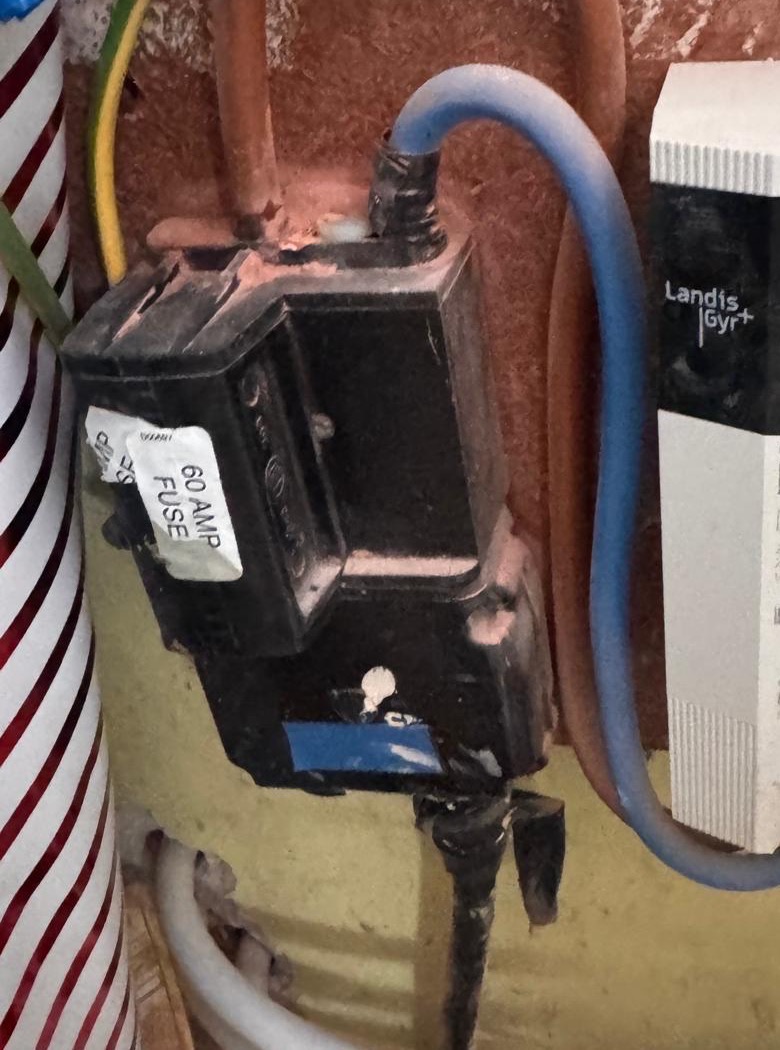
Next to your electricity meter is a black box called the cut-out, with the main fuse inside. Its rating is printed on the label: usually 60 A, 80 A or 100 A. That number decides whether a 7 kW charger can be added without the network operator first upgrading the fuse. Please do not open or remove anything; a photo of the label is enough. Some older terraced houses also have a looped supply shared with next door, which the network operator unloops before a charger goes in. After you accept the quotation we submit the application to the network operator on your behalf, and for that we need your MPAN, which is on your electricity bill.
The main fuse belongs to the network operator and is sealed. Photograph the label from the outside. If the label is missing or unreadable, say so and we will work it out from the rest of the video.
What type of fuse board you have matters too
If your board is a split-load type, we add a small dedicated consumer unit for the charger with the correct protection, rather than squeezing it into the existing board. Our guides to types of consumer unit and split-load boards explain the difference.
Tethered or untethered?
A tethered charger has its own cable attached. For one car on a drive it is the simpler choice: no cable to fetch from the boot. An untethered charger has a socket and you use your own cable, which suits households with different cars or anyone who prefers a cleaner wall when the car is away. We supply 7 kW smart chargers that schedule charging for cheap overnight tariffs, or you can name the charger you want and we will install it.
What is included in the quotation
The charger, a small dedicated consumer unit with the correct protection, the cable and fixings, labour, testing and the Electrical Installation Certificate, the Building Regulations notification, and the application to the network operator. Trenching and making good are not included, as above.
A customer in Fishponds asked whether a drive 30 metres from the house needed its own meter. It did not. The harder part was a shared path between the garden and the parking space, which pointed to moling rather than clipping the cable to the fence.
A customer with a terraced house in Yate had the fuse board at the front and the garage at the back, about 45 metres apart. The route runs up behind the drainpipe, through the loft, down the rear and along a trench he offered to dig himself. The network operator had already agreed to unloop the supply and upgrade the main fuse. He sent photos and a video, and we priced the whole job from those without a visit.
How we quote without visiting
Most of our customers send a short video on WhatsApp to 07590 517472. On a modern phone it shows everything we need, often more thoroughly than a quick visit would, and you get the quotation without taking time out of your day. Please show:
- Your fuse board with the cover open, so the switches are visible
- Your electricity meter and the main fuse next to it, with the rating label
- The route from the fuse board to where the car will park, including any patio, path or drive it crosses
- Where you would like the charger, and where the car parks
- The charger you have in mind, or ask us to recommend one
- Your full address
Questions people ask us about EV charger installation
Can an EV charger be 30 metres from the house?
Yes. Runs of 30 metres and more are common. The cable is sized for the length so the charger still delivers full power, and it runs along walls and fences or underground in ducting.
Is a separate meter for the charger cheaper?
Usually not. It needs a new connection from the network operator, with their charges and timescales, plus a second meter and standing charge. A cable run from your existing supply is one job on one day.
Do you dig the trench?
We can arrange it, but it is usually cheaper for you to dig it. We agree the depth, lay the cable in ducting and inspect the trench before it is backfilled. Making good is not included.
Why do you need a photo of the main fuse?
The rating printed on it, usually 60 A, 80 A or 100 A, decides whether a 7 kW charger can be added without the network operator upgrading the fuse first. Photograph the label only; never open the cut-out.
Do I need a site visit for a quote?
Not usually. A short walkthrough video of the fuse board, the meter and the route lets us quote properly. A visit is still available if you prefer one.
Tethered or untethered?
Tethered for one car on a drive. Untethered if different cars will charge or you want a cleaner wall when the car is away.
Our EV charger installation page has the service details. To get a quotation, send the walkthrough video to 07590 517472 on WhatsApp and we will come back with a price.
Want a price for an EV charger at your home?
Send a short walkthrough video of your fuse board, meter and the route to the car, and we quote from that. We cover Bristol, Yate and the surrounding area, and the quotation includes the certificate, the Building Regulations notification and the network operator application.